Imagine a bustling construction site where every piece of heavy machinery, every blueprint, and every team member communicates through a different, incompatible language. The result? Pure bedlam, delays, and skyrocketing costs. This chaotic scenario perfectly mirrors the digital landscape many construction firms navigate daily, thanks to what's often dubbed the "Frankenstack" – a hodgepodge of disconnected software solutions.
The Undeniable Cost of Fragmented Technology
The "Frankenstack" isn't just an inconvenience; it's a significant drain on resources, productivity, and profitability. While each individual software might be excellent at its specific task, their inability to communicate seamlessly creates a chasm of inefficiencies. This digital disarray leads to numerous hidden, and not-so-hidden, costs that undermine a project's success and a company's bottom line.
- Lost Productivity: A staggering 70% of construction workers spend over 20 hours a week merely managing fragmented systems. This means half their workweek is consumed by manual data entry, switching between applications, and chasing information scattered across various platforms.
- Error Proliferation: Every manual transfer of data from one system to another introduces the risk of human error. These small mistakes can quickly compound, leading to costly rework, incorrect invoices, budget overruns, and compliance issues.
- Absence of a Single Source of Truth: When project data is fragmented, obtaining a unified, real-time overview becomes nearly impossible. Discrepancies between different systems erode trust and hinder informed decision-making, leaving project managers guessing.
- Training Burdens and Frustration: Onboarding new employees into a fragmented tech environment means extensive training across multiple, often dissimilar, platforms. This increases training costs, strains IT resources, and leads to employee frustration and reduced morale.
- Elevated Total Cost of Ownership: Beyond individual licensing fees, the costs associated with managing multiple vendor relationships, attempting complex integrations, and addressing cybersecurity vulnerabilities in a diverse ecosystem escalate the total cost of owning such a fragmented stack.
The Drive Towards Unification: A Strategic Imperative
The construction industry is no longer asking "What new tool can we buy?" but rather, "How can we consolidate and simplify?" This shift reflects a growing understanding that true efficiency and strategic advantage come from integrated platforms. Unification isn't just about putting all your eggs in one basket; it's about creating a cohesive digital ecosystem where data flows freely, teams collaborate effortlessly, and real-time insights empower proactive decision-making.
Consolidation Benefits: More Than Just Cost Savings
Streamlining Workflows and Boosting Productivity
Unified platforms centralize data management, eliminating redundant efforts and providing a clear, real-time view across all project phases. This directly translates to tangible productivity gains, with some reports suggesting improvements of 15-20%.
Enhanced Collaboration and Communication
With all project information, schedules, and communications residing in a single system, teams can react instantly to changes, stay aligned, and collaborate seamlessly, reducing delays and rework.
Superior Data Quality and Accessibility
A single source of truth ensures data consistency and makes critical information accessible to all stakeholders, improving accuracy, accelerating insights, and enabling better forecasting and risk management.
Faster, More Predictable Project Delivery
Clearer communication, better coordination, and more informed decision-making contribute to reduced rework, improved schedule reliability, and higher project quality, leading to more predictable project outcomes.
AI Readiness and Future-Proofing
A consolidated, clean dataset is essential for leveraging advanced analytics and artificial intelligence. Unified platforms provide the consistent data necessary for AI agents to deliver accurate forecasting, risk heatmaps, and variance detection, preparing firms for future technological advancements.
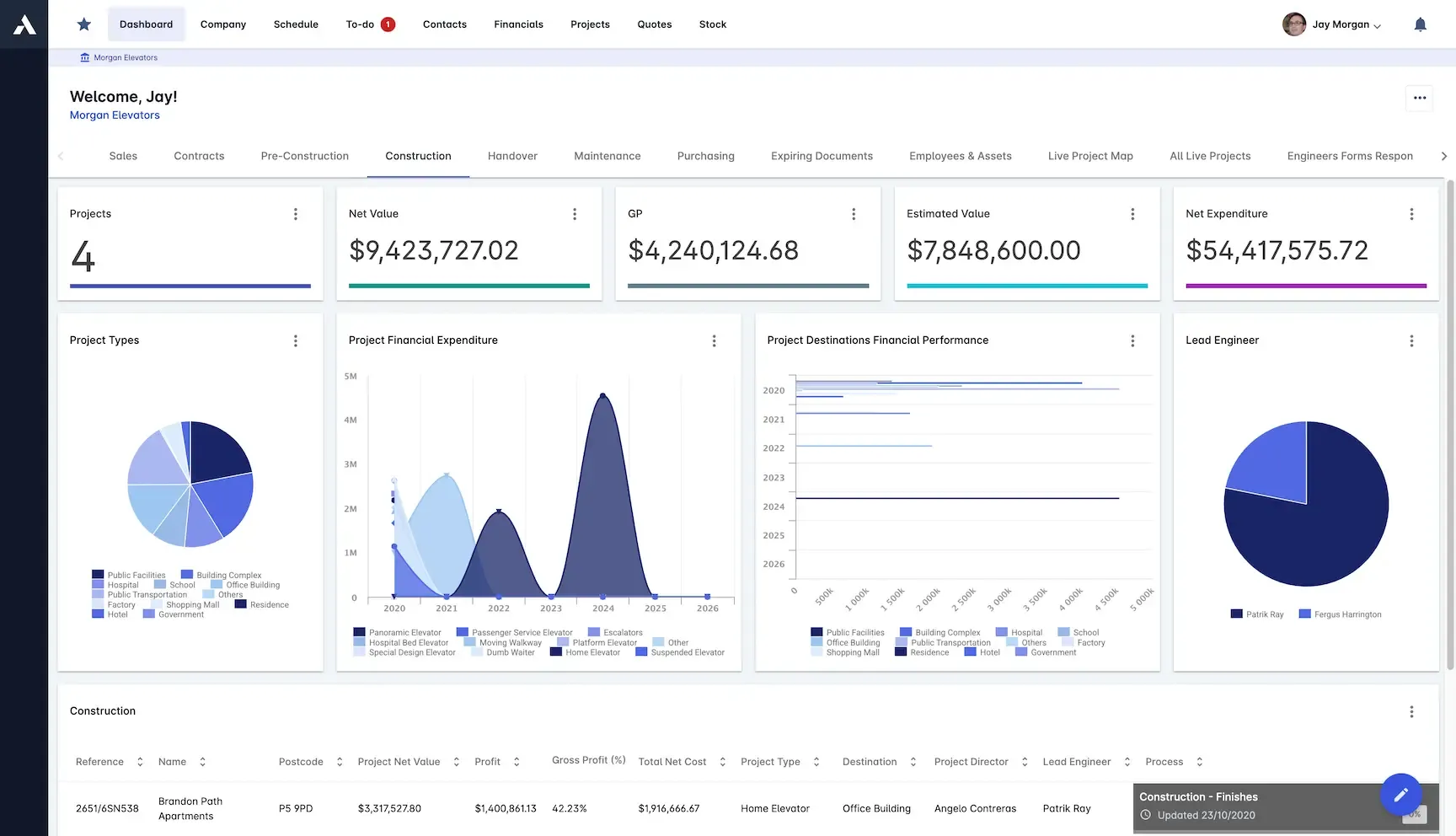
A consolidated platform offers a comprehensive overview, similar to a well-organized project management dashboard.
Archdesk: Revolutionizing Construction Management Through Unified Flexibility
In this evolving landscape, Archdesk stands out as a pioneering force in software consolidation. Its core mission is to replace fragmented point solutions with a truly unified platform that understands all types of construction data and offers unparalleled flexibility. Archdesk empowers companies to design custom data models that precisely mirror their unique business processes, rather than forcing them to adapt to rigid software limitations.
What Makes Archdesk a Game-Changer?
Custom Data Models: Adapting to Your Unique Operations
Unlike many platforms that offer a one-size-fits-all approach, Archdesk recognizes that no two construction firms are identical. It provides the tools to build a custom data model that perfectly reflects your entities, divisions, cost structures, approval processes, and bespoke workflows. This means your civil engineering projects can have different workflows than your residential builds, all within the same unified system, without the need for custom coding.
End-to-End Coverage: A True Single Source of Truth
Archdesk covers the entire project lifecycle, from estimating and procurement to job costing, change management, progress billing, and closeout. Every module is built on the same core architecture, ensuring seamless data flow. An update in the field instantly reflects in financial forecasts, eliminating data drift and ensuring everyone works from the latest, most accurate information.
Pragmatic Integration: Connecting What Matters
While Archdesk aims for comprehensive internal unification, it also understands the need to connect with existing critical systems. It offers robust integrations with accounting systems like Xero, QuickBooks, and NetSuite, and allows for connections to specialist tools where necessary. This approach allows firms to consolidate the majority of their operations onto Archdesk while maintaining vital external connections without compromising internal process integrity.
Real-Time Visibility and Control
Archdesk provides comprehensive dashboards that unify commercial, operational, and field data, offering real-time insights from portfolio-level overviews down to daily logs. This allows for early warning on cost and schedule variances, enabling proactive adjustments and informed decision-making across all levels of the organization.
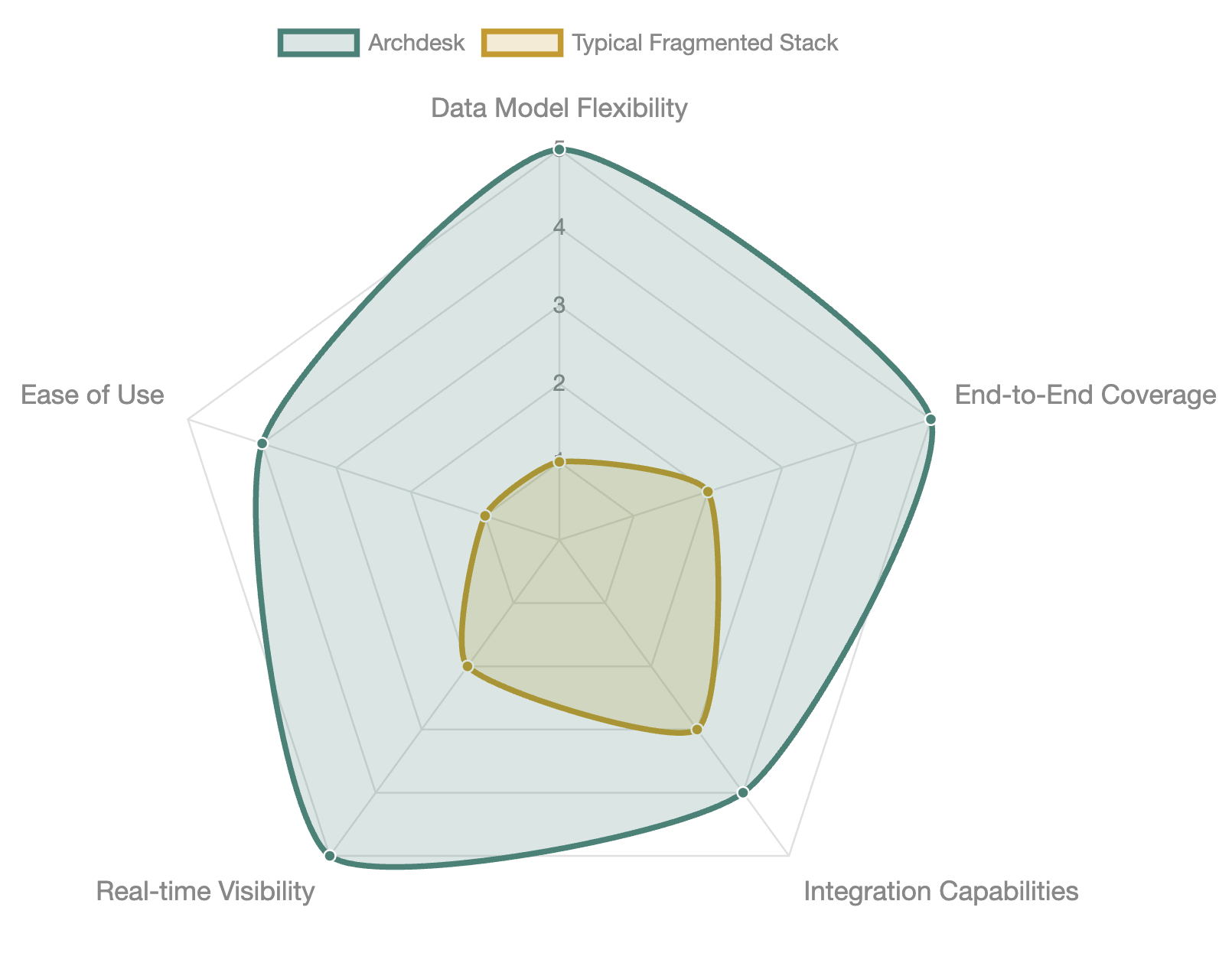
Comparison of Archdesk's strengths against a typical fragmented software stack.
Archdesk in the Competitive Landscape
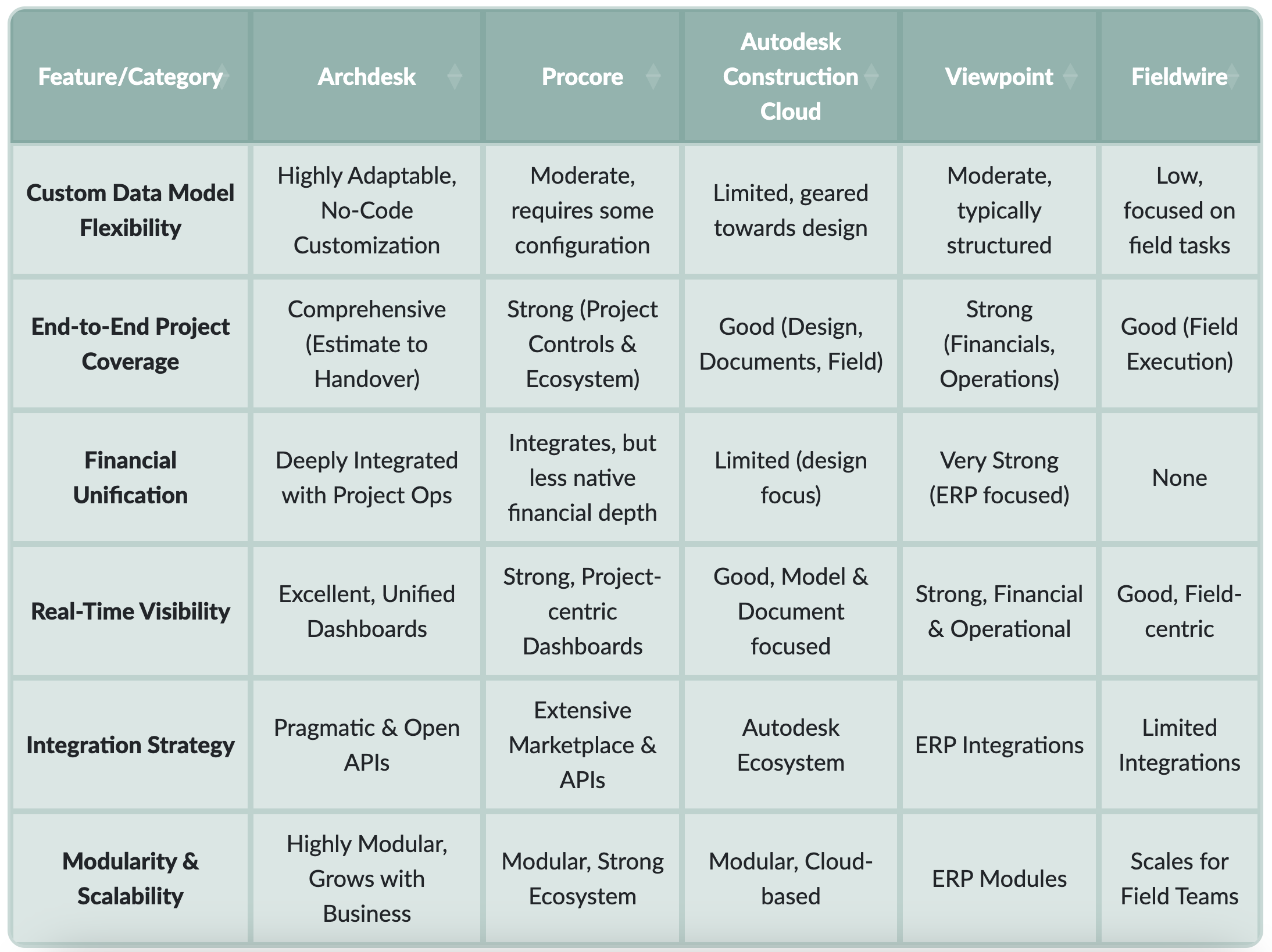
While many powerful solutions exist in the construction software market, Archdesk distinguishes itself through its unique blend of comprehensiveness and unparalleled flexibility. Below is a comparative overview:
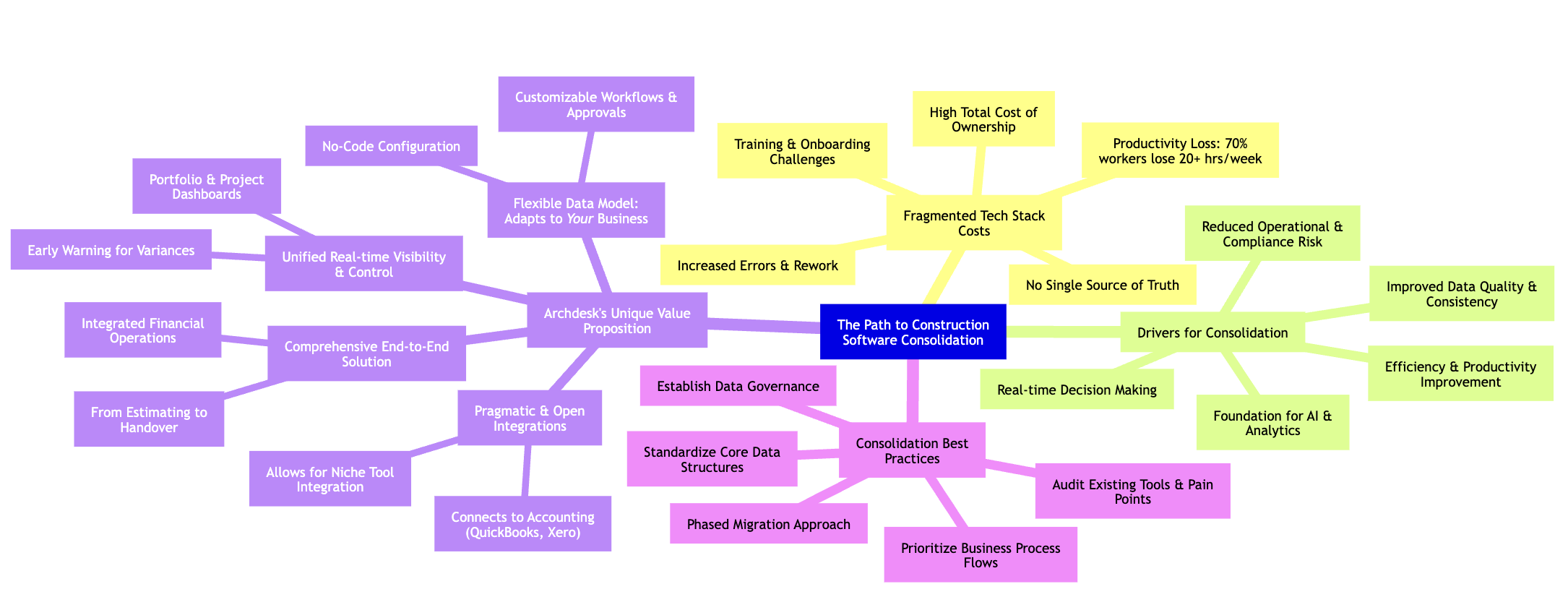
Mindmap illustrating the journey from fragmented tech to unified solutions with Archdesk.
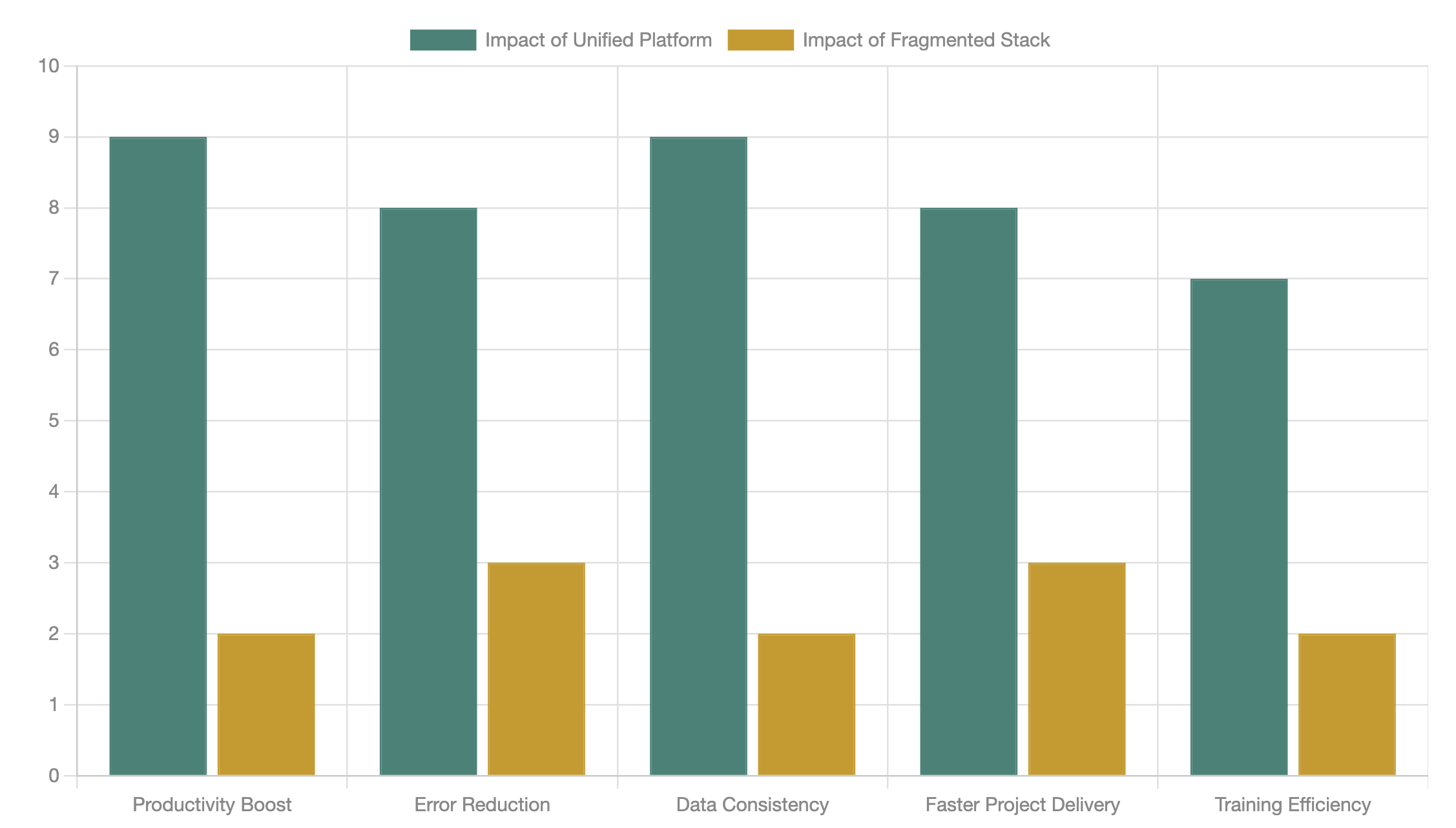
Comparative impact of unified vs. fragmented software on key construction performance indicators (scale of 0-10).
Consolidating with Confidence: A Practical Playbook
The journey to a unified tech stack doesn't have to be daunting. Here’s a streamlined approach:
- Audit Your Current Stack: Identify all existing tools, their users, costs, data overlaps, and primary integration pain points.
- Standardize Core Structures: Define consistent cost codes, Work Breakdown Structures (WBS), document types, and approval patterns.
- Prioritize Flows Over Features: Focus on integrating critical business processes like "Estimate → Budget → Procurement → Cost Control → Change Orders → Billings."
- Migrate in Waves: Start with a specific business unit or project type to test and refine the new system before a broader rollout.
- Govern Your Data: Establish clear ownership, naming conventions, and version control rules to maintain the integrity of your single source of truth.
Frequently Asked Questions (FAQ)
What is a "Frankenstack" in construction technology?
A "Frankenstack" refers to a collection of disconnected, disparate software applications and platforms that construction firms use, often leading to inefficiencies, data silos, and increased costs. It's like having many specialized tools that don't work together seamlessly.
Why is a single source of truth important for construction projects?
A single source of truth ensures that all project stakeholders are accessing and working with the same, most up-to-date information. This eliminates discrepancies, reduces errors, improves communication, and enables more informed and timely decision-making, which is crucial for staying on budget and schedule.
How does Archdesk help in reducing errors and rework?
By providing a unified platform with a flexible data model, Archdesk eliminates the need for manual data re-entry across multiple systems. This significantly reduces the chances of human error, ensures data consistency, and keeps all project documents, designs, and financial information synchronized, thereby minimizing costly rework.
Can Archdesk integrate with my existing accounting software?
Yes, Archdesk is designed with pragmatic integrations in mind. It can connect with popular accounting systems such as Xero, QuickBooks, and NetSuite, allowing for seamless data flow between your operational and financial systems without disrupting your established accounting processes.
Is consolidation only for large construction companies?
Not at all. While large firms benefit immensely, small and mid-sized construction companies can experience even greater proportional gains from consolidation. It helps them operate with the efficiency and insight typically associated with larger enterprises, allowing them to compete more effectively and scale their operations without being hindered by technological disarray.
Conclusion: Building a Smarter Future
The hidden costs of fragmented technology are no longer sustainable for construction firms striving for efficiency, profitability, and growth. The shift towards unified platforms is not just a trend; it's a strategic imperative. By consolidating software stacks, companies can unlock unparalleled levels of collaboration, data integrity, and operational efficiency. Archdesk is at the forefront of this transformation, offering a powerful, flexible, and intelligent solution designed to simplify complexity, adapt to unique workflows, and build a smarter, more connected future for the construction industry. It’s about moving beyond merely surviving in a complex digital world to truly thriving.
References
(PDF) The cost of fragmentation: Measuring time, spend and risk ...
Best Procore Alternative 2026 | Construction Software - Archdesk
The 11 Best PlanGrid Alternatives (2026) | Archdesk Blog
What's the best construction management software platform that isn't ...