
Archdesk for Mid-size Construction Companies
Growth should add projects, not chaosStandardize how every job runs and see the whole portfolio live, without burying your teams in admin.
A look at Archdesk for mid-size contractors: what changes when every project runs on the same structure, why margin stops leaking between estimate and closeout, and honest answers to the questions operations and finance leaders ask us.
Trusted by construction companies of every size, worldwide

























The habits that grew you are starting to cost you
Somewhere past the first dozen concurrent jobs, the spreadsheet era quietly ends. Every project manager runs work their own way, finance rebuilds the picture every month, and margin leaks in the gaps between tools. None of it is anyone's fault. All of it is fixable. Side by side:
You professionalized the team years ago. This is what professionalizing the operation looks like.
Standardize without the bureaucracy
Archdesk gives a growing contractor the structure of a much larger company without the overhead that usually comes with it. One platform, shaped to how you already run work.
One way of running jobs
Templates, budget structures and approval flows drawn from thousands of live construction projects. Adopt them as they are or shape them to your own standards, then every job starts organized.


The portfolio at a glance
Live dashboards across every job: progress, cost, cash and risk. You stop managing by anecdote and start managing by evidence.
Scale without key-person risk
When jobs run through the system instead of through individuals, holidays, resignations and rapid growth stop threatening delivery.
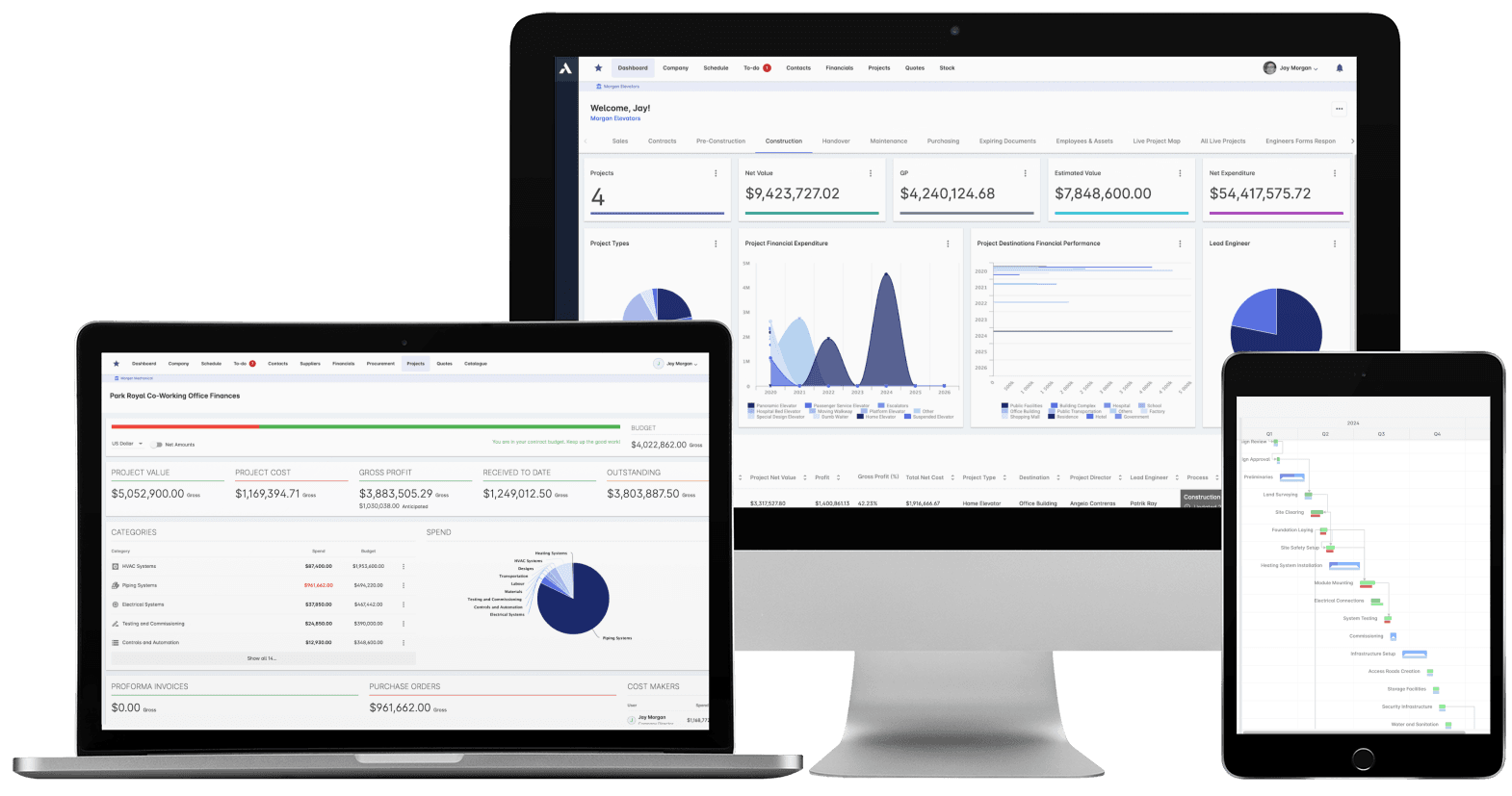
The whole portfolio in one view: WIP, cost to complete and margin on every live job.
Where mid-size contractors start
Questions mid-size contractors ask us
We run on spreadsheets and a few point tools. Why change what works?
It works because a handful of experienced people carry it, and that is exactly the risk. Every month someone consolidates numbers by hand, every handover depends on how a PM kept their files, and nobody sees margin move until it has moved. The cost of the current setup is invisible because it is paid in evenings and eroded margin, not invoices.
Will our project managers actually adopt it?
Adoption sticks when the system removes work instead of adding it, so PMs get their chasing, re-keying and report-building taken away, not another form to fill in. Rollout is phased job by job, and each person is trained on the parts they touch rather than the whole platform.
Do we have to change how we run jobs to fit the software?
No. Archdesk is configured around your budget structures, approval chains and templates. The best-practice structures that come with it are starting points you can adopt, adapt or ignore. What changes is that your way becomes the one way, applied on every job.
How does it work with our accounting system?
The books stay where they are. Archdesk integrates with Xero (as a certified partner), Sage, QuickBooks and other accounting systems, so the project side and finance stay in step without double entry.
What does implementation look like with live jobs running?
Live jobs do not stop. Implementation is done with you: structures, templates and users are set up together, and you choose which projects start on the system first. Many companies begin with new jobs on Archdesk while current ones finish where they are.
What do we get that our current mix of tools cannot give us?
One connected thread from estimate to closeout. The winning bid becomes the live budget, orders and subcontractor costs commit against it, pay applications and invoices flow from it, and reporting reads across all of it without a single export. Point tools each do a piece; the value is the thread.
See your whole portfolio in one view
In the demo we walk you through a fully worked mid-size contractor in Archdesk: live jobs, portfolio reporting, cost control and a month-end without the chase. Book a demo and see.
Book a Demo